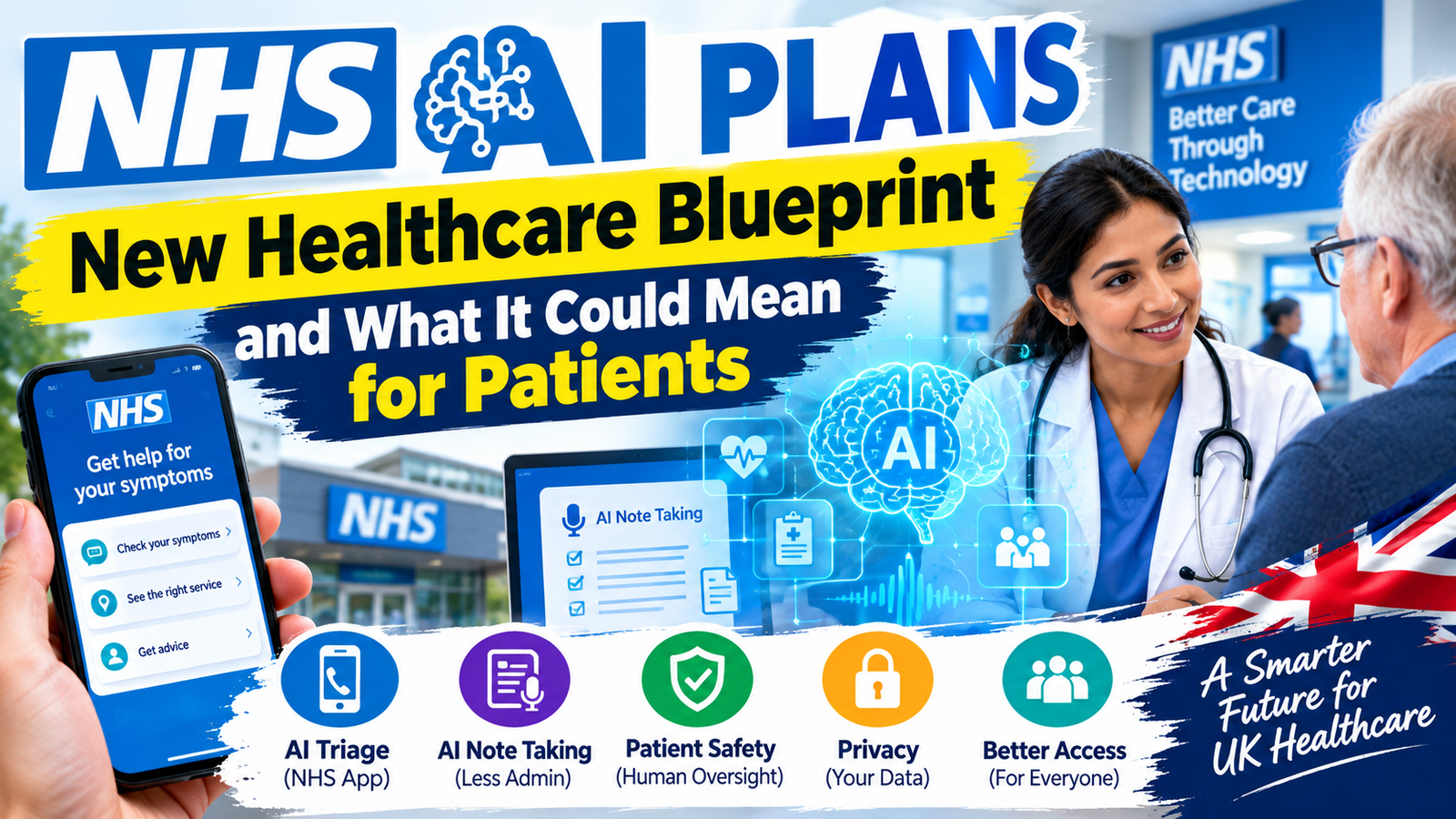
NHS AI plans 2026 : Hello Everyone, Artificial intelligence is becoming a much bigger part of healthcare in the UK, and the NHS is already using AI-supported technology in several areas. From helping patients find the right service to reducing paperwork for doctors, the technology is being introduced with the aim of improving efficiency while maintaining patient safety.
The latest development came on 10 September 2026, when the National Commission into the Regulation of AI in Healthcare published recommendations for a future regulatory framework. The recommendations focus on creating a system that can support innovation while protecting patients, maintaining safety and preserving public trust.
At the same time, NHS England is accelerating the adoption of AI tools, including AI-assisted triage through the NHS App and technology that can automatically create clinical notes from conversations between patients and healthcare professionals.
For patients, the important question is not simply whether the NHS is using AI, but how these systems will affect appointments, communication, privacy and the way healthcare decisions are made.
What Is the New NHS AI Blueprint?
The National Commission’s report is not a single new NHS treatment rule. Instead, it provides recommendations for how AI used in healthcare should be regulated in the future.
The commission says healthcare AI regulation should become more proportionate, lifecycle-based and system-wide. The aim is to make sure that regulation keeps pace with rapidly developing technology without removing the safeguards needed to protect patients.
A cross-government response will follow separately, meaning the recommendations should not be interpreted as every proposed measure already being fully implemented.
This distinction is important because headlines about a “new AI blueprint” can sometimes make recommendations sound like immediate changes to NHS services.
AI Is Already Being Used Across the NHS
The NHS is not waiting for the new regulatory framework before using artificial intelligence.
NHS England announced in July 2026 that it was accelerating the rollout of AI tools designed to help reduce waiting times and improve care.
One of the major developments is an AI triage tool being introduced through the NHS App. During its trial, the system was designed to ask patients questions about their symptoms and then help direct them towards an appropriate service, such as a GP appointment, pharmacy, A&E, community service or self-care advice.
The tool is expected to reach more than 200,000 patients within 12 months of the July announcement, with the aim of making it available to all NHS App users by April 2028.
This does not mean AI is replacing doctors.
Instead, the technology is being positioned as a way of helping patients reach the right part of the health service and providing clinicians with more useful information before an appointment.
What Could AI Triage Mean for Patients?
For some patients, AI-assisted triage could make accessing NHS services more convenient.
Instead of spending a long time trying to determine whether they need a GP, pharmacy, urgent treatment centre or another service, patients may be able to describe their symptoms through the NHS App and receive guidance about the most appropriate route.
NHS England says an initial trial at a GP practice in Sussex resulted in a 29% reduction in the number of people queuing on the phone, while patient satisfaction was maintained.
However, patients should understand that an AI triage system is not the same as receiving a medical diagnosis.
A patient’s symptoms can be complicated, change over time or require professional judgement. AI-supported systems therefore need appropriate clinical oversight and safeguards.
The NHS has also said that traditional ways of contacting GP practices will continue to be available alongside the new AI triage tool.
AI Could Reduce Paperwork for Doctors
Another major part of the NHS AI rollout involves ambient voice technology.
These systems can record a patient-clinician conversation and use AI to produce draft clinical notes, letters or other documentation.
The intention is to reduce the amount of time healthcare professionals spend typing and completing administrative tasks.
NHS England has been supporting the adoption of this technology across NHS organisations. In July 2026, NHS England and the MHRA also published guidance explaining the regulatory position of ambient voice technology products.
The technology does not simply mean that an AI-generated note is automatically placed into a patient’s record without review.
NHS guidance stresses the importance of appropriate safeguards, accuracy checks, privacy, consent, information governance and clear accountability for the use of AI-generated outputs.
Patients Should Still Expect Human Oversight
One of the biggest concerns surrounding healthcare AI is whether a computer could eventually make important medical decisions without enough human involvement.
The current approach places significant emphasis on safety and clinical responsibility.
For ambient voice technology, NHS guidance states that AI-generated outputs may contain inaccuracies and need to be reviewed to ensure accuracy. Organisations are also expected to consider risks involving privacy, consent, information quality and automation bias.
This means AI should be viewed as a support tool rather than an automatic replacement for clinical judgement.
The new regulatory recommendations are also designed around maintaining public trust and patient safety while allowing useful technologies to develop.
What About Patient Privacy?
Privacy is likely to remain one of the most important issues as AI becomes more widely used in healthcare.
Some AI systems need access to information generated during consultations or other healthcare processes. Patients therefore have a legitimate interest in understanding how information is collected, processed and protected.
NHS England’s guidance on ambient voice technology highlights information governance, privacy and consent as important considerations when organisations introduce these systems.
Healthcare organisations are responsible for ensuring that the technology they use is appropriate and safely integrated into existing clinical processes.
Patients should therefore not assume that every AI product works in exactly the same way. Different systems can have different functions, safeguards and regulatory classifications.
AI Could Give Doctors More Time With Patients
One of the strongest arguments for expanding AI in healthcare is the potential to reduce administrative work.
NHS England reported that an NHS-sponsored study found AI notetaking tools could increase direct patient interaction time during appointments. Another NHS announcement in January 2026 said AI notetaking technology could potentially free clinicians to spend up to a quarter more time with patients.
In practice, this could mean doctors and other healthcare professionals spend less time looking at computer screens and more time speaking directly with patients.
However, these benefits depend on proper implementation. AI-generated notes still need appropriate review, and healthcare organisations must make sure that efficiency does not come at the expense of safety.
Will Every NHS Patient Have to Use AI?
No.
The current NHS plans do not mean that patients will suddenly be forced to use AI for every healthcare interaction.
The NHS App is being developed as an increasingly important route for accessing services, but NHS England has stated that traditional methods of contacting GP practices will continue alongside the AI triage tool.
This is particularly relevant for people who are less comfortable using smartphones or online services.
Digital healthcare can offer convenience, but accessibility remains important. A modern NHS needs to make sure that people who cannot or do not want to use digital tools are not unnecessarily excluded from care.
What Should Patients Know About AI-Assisted Healthcare?
Patients do not need to become technology experts to understand the basic principles.
If an NHS service introduces an AI-supported system, patients should understand what the system is designed to do and what role healthcare professionals continue to play.
It is also reasonable to ask questions about how information is being used when an AI tool records or processes part of a healthcare interaction.
For technologies such as ambient voice systems, consent, privacy and accuracy are already highlighted in NHS guidance.
Patients should also remember that an AI tool providing information about symptoms is not necessarily providing a medical diagnosis.
If symptoms are serious, worsening or concerning, appropriate medical assistance should be sought rather than relying solely on an automated system.
What Happens Next?
The September 2026 recommendations are an important step, but they are not the final stage of the process.
The National Commission has published its recommendations, and a cross-government response is expected separately. That response will help determine how the recommendations are considered and implemented.
Meanwhile, NHS England is continuing with practical AI deployment.
The NHS has announced funding and technology plans covering areas such as AI-assisted triage, ambient voice technology and other digital systems designed to improve productivity and patient access.
This means patients are likely to encounter AI-supported NHS services more frequently over the coming years.
Final Takeaway
The NHS AI plans 2026 represent a significant step in the UK’s approach to artificial intelligence in healthcare.
The latest regulatory recommendations aim to create a framework that allows useful AI technology to develop while protecting patient safety and maintaining public confidence.
At the same time, NHS England is already introducing AI-assisted triage and expanding the use of AI notetaking technology across healthcare services.
For patients, the biggest potential benefits are greater convenience, faster access to the appropriate service and more time for healthcare professionals to spend with patients.
There are also important questions around privacy, accuracy, consent and human oversight. These issues are being addressed through NHS guidance and the emerging regulatory framework.
The key message is therefore not that AI is replacing NHS doctors. Instead, the current direction is towards using AI as a support tool while keeping clinical responsibility, safety and patient trust at the centre of healthcare.
As the recommendations are considered by government and AI adoption continues, patients should expect more technology within NHS services—but they should also expect appropriate safeguards and human oversight to remain an essential part of their care.
Disclaimer: This article is for general informational purposes only and does not constitute medical, legal or financial advice. NHS services, AI systems and regulatory requirements can change. Patients should use official NHS and GOV.UK information for current guidance and seek appropriate healthcare advice for individual medical concerns.