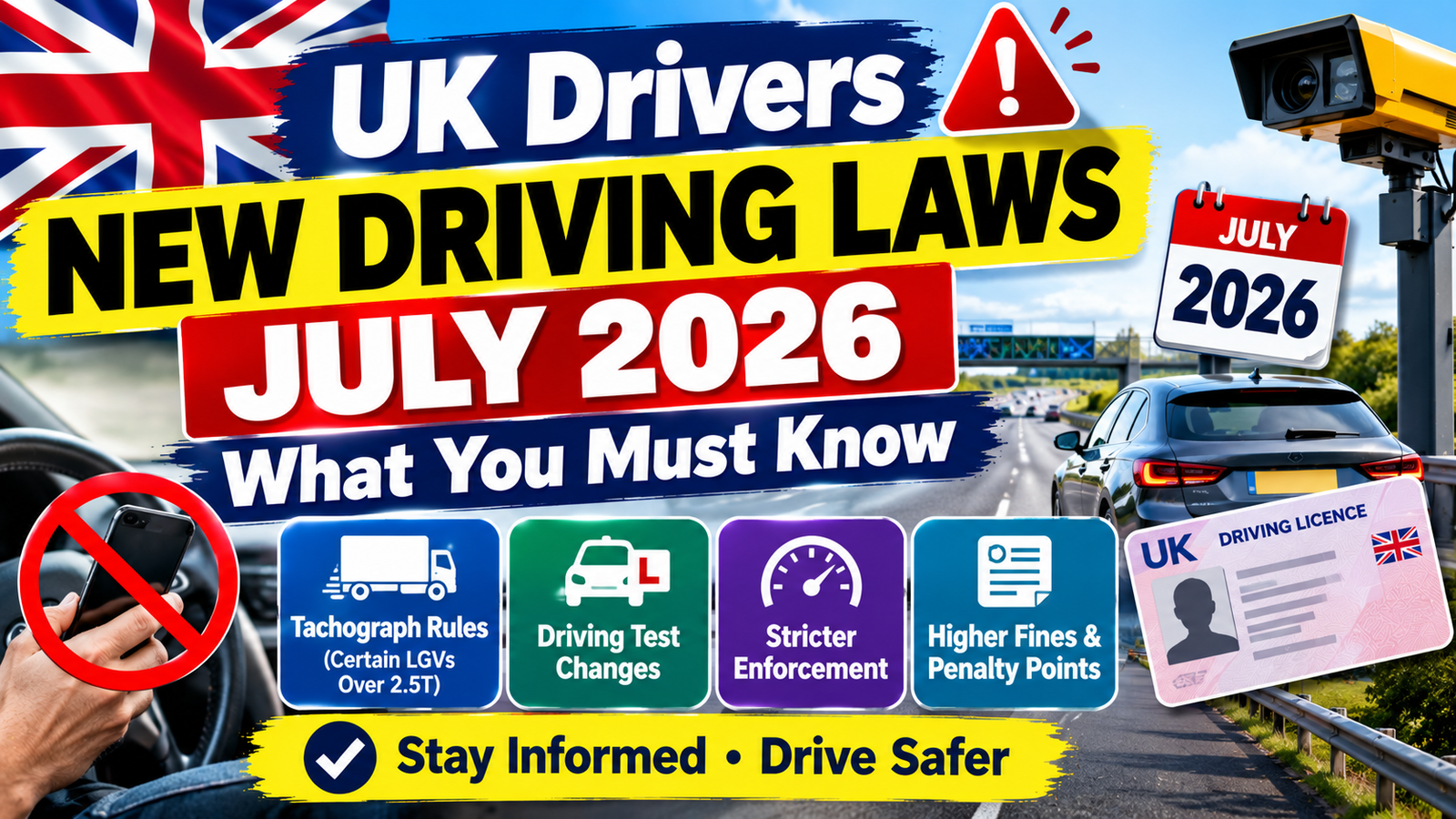
Hello Everyone, There has been growing interest online in UK Drivers Warning New Driving Laws July 2026, but motorists should be careful when reading headlines claiming that a completely new set of rules applies to every driver from July.
Official government guidance confirms that an important change did take effect on 1 July 2026, but it is targeted at a specific category of goods vehicle drivers involved in international transport. At the same time, other driving-related changes introduced during 2026 affect car driving-test bookings and management.
These developments are important, but they should not be confused with a nationwide new law that changes the everyday rules for every private car driver in the UK.
What Changed on 1 July 2026?
From 1 July 2026, the assimilated drivers’ hours rules apply to certain light goods vehicles weighing more than 2.5 tonnes and up to 3.5 tonnes when they are used for international transport operations, including certain journeys between the UK and the European Union.
Where the rules apply, the vehicle must generally have a tachograph fitted and the driver must use it to record driving time, breaks, rest periods and other relevant activities.
This is a significant change for affected operators and professional drivers, but it does not mean that every person driving an ordinary car in Britain suddenly needs a tachograph.
The rules apply according to the vehicle, the type of journey and whether an exemption applies.
Which Drivers Need to Pay Attention?
The July change is particularly relevant to businesses and drivers operating light goods vehicles on international journeys.
A vehicle can fall within the rules when its maximum permissible mass, including any trailer or semi-trailer, exceeds 2.5 tonnes and it is being used for qualifying international transport operations.
Drivers and operators should therefore establish the maximum permissible mass of the vehicle rather than relying simply on the vehicle’s physical size.
The official guidance also explains that the rules apply to relevant international transport operations, including cabotage. Certain exemptions and national derogations can apply, so operators should check the detailed requirements for their particular journey.
What Is a Tachograph?
A tachograph is a device used to record information about a vehicle and its driver.
For drivers covered by the relevant rules, it can record driving time, breaks, rest periods and other categories of activity.
The purpose is to help enforce drivers’ hours requirements and prevent excessive driving without appropriate rest.
For a business operating vehicles internationally, failing to understand when tachograph rules apply can create compliance problems. Drivers should know how to use the equipment correctly and keep the required records.
Does the July Rule Apply to Normal Car Drivers?
For most private motorists, the answer is no.
A person driving an ordinary family car for personal journeys is not suddenly brought under the international goods-vehicle tachograph rules simply because July 2026 has arrived.
This distinction is important because online headlines can make a specialist transport regulation sound like a new rule affecting every motorist.
The official guidance specifically describes the July change in relation to light goods vehicles used for international transport operations.
Private drivers should continue following the normal rules covering speed limits, mobile-phone use, insurance, MOT requirements, vehicle tax and other applicable road laws.
Driving-Test Rules Also Changed During 2026
Another important development for motorists concerns practical car driving tests.
The Driver and Vehicle Standards Agency introduced new rules for booking and managing car driving tests in stages during 2026.
Since 31 March 2026, candidates have been allowed only two changes to their driving-test booking, rather than the previous six.
From 12 May 2026, only the learner themselves can book or manage their car driving test. Unofficial services using automated systems to search the booking service are also no longer permitted.
These changes are particularly relevant to learner drivers rather than people who already hold a full driving licence.
The purpose is to make the booking system fairer and reduce problems associated with third-party test reselling and automated booking services.
What If Your Test Was Already Booked?
Existing test bookings were also covered by transitional arrangements.
According to DVSA guidance, if a test had already been booked before 9 June 2026, the new change rules apply according to where the test was booked on 9 June rather than necessarily the centre where the original booking was made.
The number of permitted changes remains limited, and candidates should check the official DVSA guidance before attempting to move a test.
This is particularly useful for learner drivers who may have heard conflicting information from unofficial test-booking websites.
Are AI Cameras Bringing New July Fines?
There is considerable online discussion about AI cameras, mobile-phone detection and increasingly sophisticated traffic enforcement.
Technology is certainly being used and developed to support road safety and enforcement, but drivers should not assume that every online claim about a new July 2026 camera penalty represents a new nationwide law.
Existing offences such as speeding, using a handheld mobile phone while driving and failing to comply with road signs already carry penalties.
The safest approach is to follow the existing Highway Code and check official government announcements before believing claims about a new camera automatically issuing a particular fine.
The Highway Code remains the central source of guidance for road users, and its official update history can be checked through GOV.UK.
What About Mobile Phones While Driving?
The basic rule remains important regardless of any new technology.
Drivers must not use a handheld mobile phone or other prohibited handheld interactive communication device while driving or supervising a learner driver, subject to limited legal exceptions.
Drivers should therefore avoid using a phone to text, make calls, take photographs or perform other activities while driving.
Even when an online story describes a new enforcement system, motorists should not wait for a new law before changing unsafe habits.
What Should UK Drivers Do Now?
For most private motorists, there is no reason to panic because of headlines about July 2026.
Instead, drivers should check the rules that actually apply to their circumstances.
If you operate a light goods vehicle internationally, check whether the vehicle is above the relevant 2.5-tonne threshold and whether the journey falls within the assimilated drivers’ hours rules. If it does, make sure the tachograph requirements are understood and followed.
If you are a learner driver, make sure you understand the new practical-test booking restrictions and do not rely on unofficial services to find or manage test appointments.
For ordinary private motorists, continue checking your driving licence, insurance, MOT and vehicle-tax status and follow the Highway Code.
Why Checking Official Sources Matters
Driving-law stories can spread rapidly on social media, particularly when headlines use phrases such as “new law”, “huge fine” or “all drivers affected”.
The reality can be much narrower.
A rule may apply only to professional drivers, specific vehicle weights, international journeys or particular circumstances.
That is exactly why drivers should check GOV.UK, DVSA and other relevant official sources before changing their driving arrangements or paying attention to an online claim.
Final Verdict
The UK Drivers Warning New Driving Laws July 2026 discussion needs some important context.
There is a genuine change from 1 July 2026 involving assimilated drivers’ hours and tachograph requirements for certain light goods vehicles over 2.5 tonnes used on qualifying international transport operations.
There are also separate 2026 changes affecting the booking and management of car driving tests, including restrictions introduced from March and May.
However, these changes should not be presented as a single new set of laws affecting every UK car driver from July.
For ordinary motorists, the best protection against fines and unnecessary costs remains straightforward: follow the existing road rules, keep your licence and vehicle documents up to date, avoid distractions and verify major legal claims through official government sources.
The key message is simple: know which rule applies to your vehicle and your journey before assuming that a headline applies to you.
Disclaimer: This article is for general information and does not constitute legal or professional transport advice. Rules can vary according to vehicle type, journey, location and exemptions. Drivers and operators should check the latest official GOV.UK guidance for their specific circumstances.