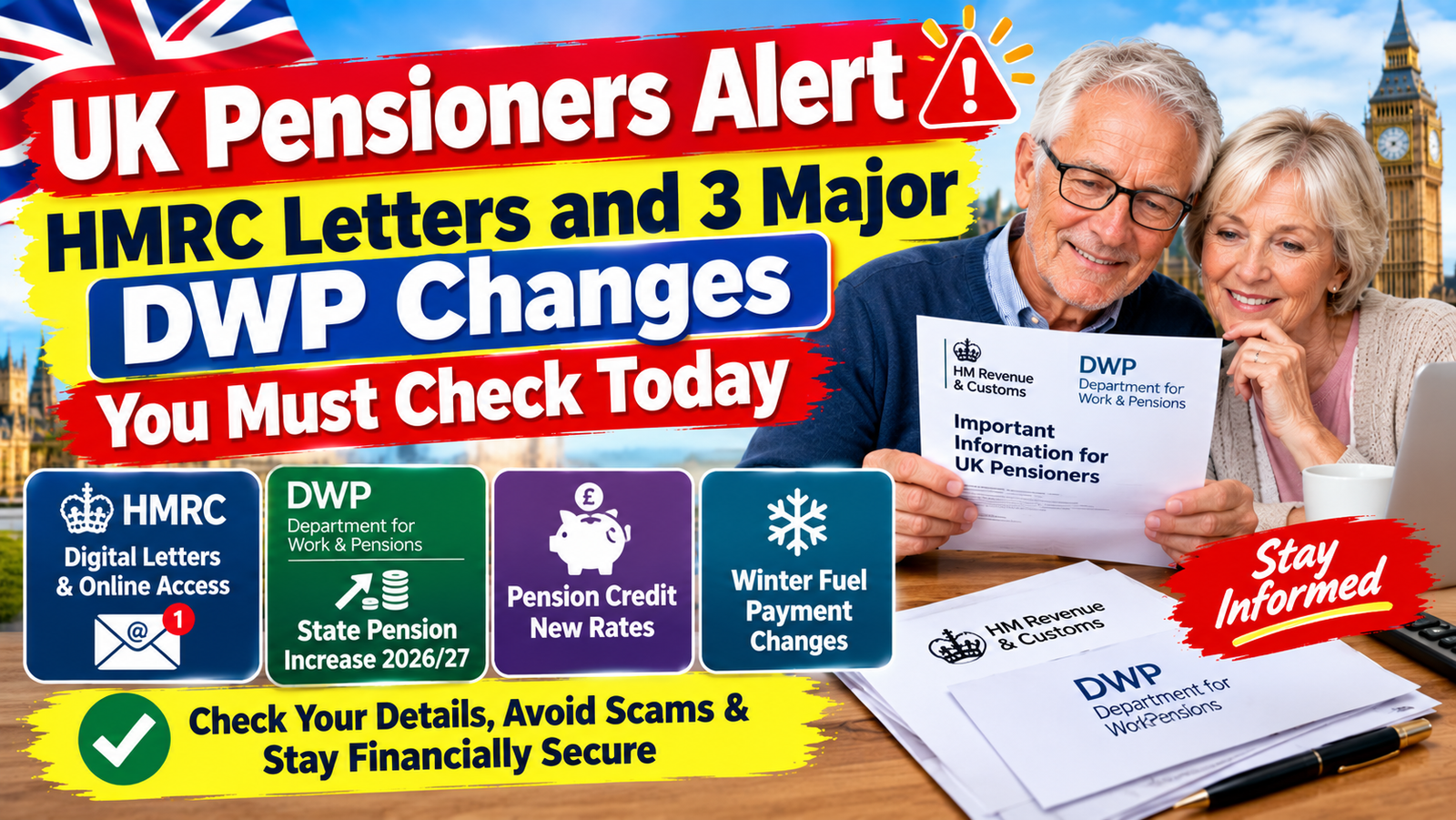
Hello Everyone, For UK pensioners, keeping track of changes to tax, State Pension and financial support can sometimes be difficult. Government departments regularly update payment rates, communication systems and benefit rules, and an important letter or online notice can sometimes require attention.
In 2026, there are several developments worth knowing about. HMRC is moving more of its communications towards digital delivery, while State Pension and Pension Credit rates have changed for the 2026/27 tax year. There are also important Winter Fuel Payment arrangements that pensioners should understand before winter.
These changes do not mean that every pensioner will receive the same letter or payment. Eligibility depends on individual circumstances. The safest approach is to check official GOV.UK information and carefully review any genuine HMRC or DWP correspondence.
1. HMRC Is Moving More Letters Online
One of the most significant administrative changes concerns the way HMRC communicates with people who already use its digital services.
HMRC announced that from spring 2026 it would be able to operate a “digital by default” model for outbound communications. Customers who use HMRC’s online services can receive digital letters instead of paper letters as different services and systems are gradually brought into the new arrangement.
This does not mean that every pensioner will suddenly stop receiving post.
HMRC says customers can opt out of digital communications if they need information by post, while people who are digitally excluded will continue to receive paper communications. The rollout is also gradual rather than one single change affecting every HMRC service at the same time.
What Should UK Pensioners Check?
If you use an HMRC online account or the HMRC app, it is sensible to make sure your contact details are up to date.
You should also regularly check your secure HMRC account for important notices, particularly if you receive a private or workplace pension alongside your State Pension.
Most importantly, be careful with unexpected emails or text messages. A message claiming that you are owed a tax refund or asking for bank details should not automatically be trusted.
When in doubt, access GOV.UK directly rather than using a link contained in an unexpected message.
2. State Pension Rates Have Increased for 2026/27
The second important change for UK pensioners is the annual State Pension uprating.
For the 2026/27 tax year, the full rate of the New State Pension is £241.30 a week. This compares with £230.25 a week in 2025/26. The increase is 4.8%.
The exact amount an individual receives can be different from the full rate.
Your State Pension depends on your National Insurance record and other circumstances. GOV.UK explains that not everyone qualifies for the full New State Pension amount.
People receiving the old State Pension can also see an increase. The basic Category A or B pension rate for 2026/27 is £184.90 a week, compared with £176.45 in 2025/26.
This is an important reason for pensioners to check their actual payment rather than assuming that everyone receives the same amount.
Will the State Pension Increase Affect Tax?
For some pensioners, the relationship between pension income and tax is also worth watching.
The standard Personal Allowance remains £12,570 for the 2026/27 tax year. Income above the applicable tax-free allowance can be subject to Income Tax.
This does not mean that receiving a State Pension automatically makes someone a taxpayer.
For example, someone whose total taxable income remains within their available Personal Allowance will generally not pay Income Tax. However, a pensioner with State Pension, a workplace pension, private pension income, savings interest or other taxable income may need to check their overall position.
If HMRC changes your tax code, it is worth reading the notice carefully and checking that the income figures used are correct.
3. Pension Credit Rates Have Also Changed
Another important development for lower-income pensioners concerns Pension Credit.
Pension Credit is designed to provide additional support for people who have reached State Pension age and have a low income. It is separate from the State Pension itself.
For 2026/27, the standard minimum guarantee is £238 a week for a single person and £363.25 a week for a couple. Other additional amounts can apply depending on circumstances.
The amount someone receives depends on their individual circumstances, including income and certain savings or investments.
GOV.UK explains that savings and investments of £10,000 or less do not affect Pension Credit. Above that level, the calculation can take savings into account when determining entitlement.
This is why pensioners on a modest income should not assume they are automatically ineligible simply because they have some savings.
Why Pension Credit Matters
Pension Credit can be particularly important because eligibility can be connected with other forms of support.
For this reason, anyone who believes their income may be low enough to qualify should check the official Pension Credit rules rather than relying on assumptions.
A change in household income, living arrangements or pension income can also affect entitlement, so keeping the DWP informed about relevant changes is important.
Winter Fuel Payment Is Another Important 2026 Change
Winter support is another area that UK pensioners should understand before the colder months.
For winter 2026/27, people who were born on or before 27 June 1960 and normally live in England, Wales or Northern Ireland could qualify for a Winter Fuel Payment of between £100 and £300, depending on their circumstances.
Scotland has a separate system called Pension Age Winter Heating Payment.
Most eligible people do not need to make a claim if they already receive certain benefits, including State Pension or Pension Credit. However, there are circumstances where a claim may be necessary, such as if someone has deferred their State Pension since their last Winter Fuel Payment.
When Will Winter Fuel Letters Arrive?
This is particularly relevant to the “letters” part of the story.
GOV.UK says eligible people should receive a Winter Fuel Payment letter in October or November 2026, explaining how much they will receive. Most payments are expected to be made automatically in November or December.
The qualifying week for winter 2026/27 is 21 to 27 September 2026, so pensioners should pay attention to their circumstances during that period.
Higher-Income Pensioners Need to Understand the £35,000 Rule
There is also an important HMRC-related point concerning Winter Fuel Payment.
For 2026/27, if a pensioner’s total income is over £35,000, HMRC will recover the full Winter Fuel Payment through the tax system, subject to the rules and exemptions. The payment itself remains non-taxable, but an equivalent tax charge can be collected through PAYE or Self Assessment.
For PAYE taxpayers, HMRC can make the adjustment through the tax code.
This is one reason why pensioners should not ignore an HMRC coding notice. A change in tax code can affect how much tax is deducted from pension income or other PAYE income.
What UK Pensioners Should Check Now
There is no need for pensioners to panic about government letters or social media claims.
Instead, a few straightforward checks can help avoid problems.
Check Your HMRC Account
If you use HMRC online services, make sure your contact details are correct and look for any genuine digital correspondence.
Check Your State Pension Payment
Compare your current payment with the amount you expected to receive after the April 2026 uprating. Remember that individual State Pension amounts vary.
Check Pension Credit Eligibility
If your income is relatively low, check whether you could qualify for Pension Credit. Do not assume that having savings automatically rules you out.
Watch for Winter Fuel Correspondence
If you may qualify for Winter Fuel Payment, look out for the official letter expected during October or November 2026.
Review Tax Codes Carefully
If HMRC sends a new tax code, check that the pension and other income figures used in the calculation are accurate.
Be Careful About Scams
Government payment changes often create opportunities for scammers.
Fraudulent messages may claim that a pensioner is entitled to a special payment and then ask for bank details, passwords or other personal information.
GOV.UK specifically warns Winter Fuel Payment recipients about scams and says suspicious messages asking for personal or bank details should be treated carefully.
A genuine government announcement does not mean that every message using the DWP or HMRC name is genuine.
If you receive an unexpected message, do not provide sensitive information simply because the message uses government logos or official-looking language.
Final Takeaway for UK Pensioners
There are several genuine developments that UK pensioners should understand in 2026, but they are not all part of one single new pension rule.
HMRC is gradually moving eligible digital-service users towards digital correspondence, while paper communication remains available for people who need it.
The full New State Pension has increased to £241.30 a week for 2026/27, while Pension Credit’s standard minimum guarantee has also increased.
Winter Fuel Payment arrangements have also changed, with eligible pensioners potentially receiving between £100 and £300 and higher-income recipients subject to recovery through the tax system under the £35,000 rule.
The most important step is therefore not to react to alarming headlines, but to check your own circumstances and read genuine HMRC and DWP correspondence carefully.
For personalised information about your State Pension, tax position or benefit entitlement, always use the official GOV.UK services or seek appropriate professional advice.
Disclaimer: This article is for general information only and is not financial, tax or legal advice. Government rules and individual entitlements can change, so check the latest official GOV.UK guidance for your circumstances.